Baofeng UV-B5 · Volume 1
Baofeng UV-B5 — Vol 1: Introduction & Hardware
Earlier-generation Baofeng workhorse
1.1 About this volume
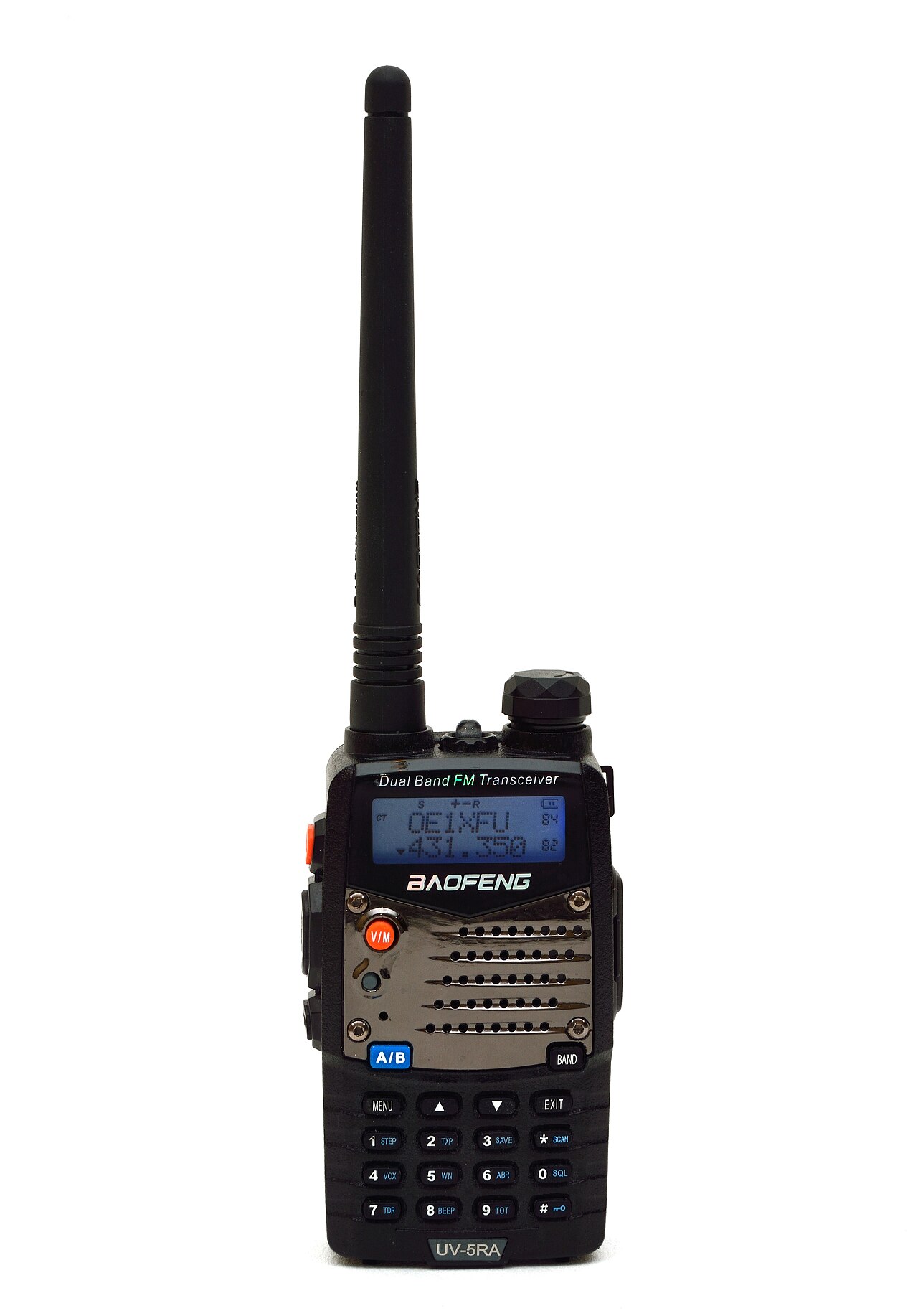
The Baofeng UV-B5 is the legacy / earlier-generation dual-band ham handheld in the bench drawer — Baofeng’s pre-UV-5R-popularity-wave product, introduced ~2012-2013. It predates the UV-5R explosion that made “Baofeng” a household name in ham circles, and it predates the mature-CHIRP-driver era that followed it. The UV-B5 is a 5 W TX dual-band (2 m / 70 cm) HT with a rotary channel knob on top, a separate volume control, and a distinctly orange-backlit dot-matrix LCD that distinguishes it visually from every UV-5R variant that came later.
Why it’s still in the bench drawer in 2026: it’s a reliable backup-of-the-backup. This unit has been owned a long time, programmed and re-programmed across many configurations, the CHIRP driver for it is solid (one of the earlier-supported community drivers, by now well-debugged), and the basic FM-on-2m/70cm function works. It’s an honest tool — the rotary channel knob is a tactile interface that some operators (especially the over-60 crowd) still prefer over the menu-and-keypad UI of every UV-5R-family successor.
Why someone wouldn’t reach for it as a daily driver in 2026: superseded for active use by the Baofeng F8HP ↗ (8 W UV-5R lineage with a more refined feature set) and the AnyTone AT-D878UVII PLUS ↗ (DMR + analog, vastly better receive audio, modern CPS). The UV-B5 is archival-functional, not first-pick — the UI is slower, the receive audio noisier, the form factor older. It still works; it’s not what you choose if any of the other Baofengs are available.
Two Baofengs, two chapters: Vol 6 (F8HP) covers the modern Baofeng experience; this volume covers the legacy experience and what’s specifically different about the B5 silicon (different battery form factor, different chassis, different display, different CHIRP driver quirks).
This is a Part 97 amateur transceiver — TX on amateur 2 m and 70 cm under the Extra-class authorization. The UV-B5 is not FCC Part 95 GMRS-certified; TX into GMRS frequencies, even though the radio is physically capable, is not lawful.
1.2 Hardware tour
Chassis and form factor. The UV-B5 is slightly more squared and less curved than the UV-5R family. Chassis is typical Baofeng-grade injection-molded plastic — not the rubberized polycarbonate of the F8HP. Has aged well in the bench drawer; no cracking or seam separation. Weight ~200 g with battery (TBD — verify against the unit). Dimensions roughly 110 × 58 × 33 mm.
Controls. The defining feature is the rotary channel selector knob on the top of the radio, paired with a separate volume knob next to it. This is the architectural break with the UV-5R series, which has only a single combined volume / channel-select rotary and forces all channel navigation through the keypad or up/down keys. The PTT and the mic / aux jack live on the left side (Kenwood K-1 / K-2 two-pin convention — same connector family as the F8HP and the vast majority of Chinese dual-band HTs). The keypad below the display is a standard 4 × 4 dialer-plus-function layout. There is a side function key (sometimes used for monitor / squelch override). NO USB-C, NO USB charging at all — the battery charges through a desktop drop-in cradle that connects via the battery’s rear charging contacts.
Display. Orange-backlit dot-matrix LCD. The orange is the visual signature that distinguishes the UV-B5 from a UV-5R at across-the-bench glance. Resolution is small (TBD exact pixel count — sufficient for two-line frequency / channel display plus icons; not graphical). Backlight is adequate for indoor and shade use; struggles in direct sunlight like every LCD of its generation.
Antenna jack. SMA, reverse-Baofeng convention — the radio body has a male SMA (pin-out), antennas are SMA-female. Inverse of the Yaesu/Icom/Kenwood convention; same as every Baofeng/Wouxun/TYT HT of the era. When swapping antennas between platforms, check the gender; an SMA-female-to-SMA-female adapter is a useful bench-drawer accessory.
Battery. Ships with the BL-B 1800 mAh Li-ion (per Baofeng — TBD verify exact capacity printed on the unit). The BL-B is a different physical form factor from the BL-5 (UV-5R) and the BL-8 (F8HP / UV-82); contact arrangement and case dimensions are not interchangeable. Aftermarket replacements are scarcer than BL-5 / BL-8; if it fails, plan on hunting eBay or Aliexpress and verifying chemistry (Li-ion) and capacity before paying. The 5-year-and-up age of any BL-B in circulation means runtime is degraded — probably 60-80% of nameplate on a well-stored cell. Not a unit for extended deployment without a known-good backup.
TX power. 5 W maximum on both 2 m and 70 cm, with a low-power (~1 W) option selectable from the menu. There is no 8 W mode (that’s the F8HP’s distinguishing feature). For repeater-reachable operating in moderate terrain with a decent antenna, 5 W is fully adequate; for marginal repeater paths or simplex over hills, the F8HP’s extra 3 dB matters.
Comments (0)