Baofeng F8HP · Volume 1
Baofeng F8HP — Vol 1: Introduction & Hardware
8-watt 2m/70cm handheld — high-output Baofeng
1.1 About this volume
The BaoFeng BF-F8HP is the 8-watt sibling to the ubiquitous UV-5R, distributed in the US through BaofengTech. It earns its bench slot precisely because it is the cheapest credible dual-band HT that puts an honest 8 W on 2 m and 70 cm — $60-70 at mid-2026 street, throws into the glovebox or the go-bag without complaint, and can be lost or destroyed without ceremony.
The 8-watt rating is the single distinguishing claim against the UV-5R (5 W) and the sea of $25-30 Baofeng clones. Whether 8 W vs 5 W matters operationally is a fair question: 2 dB of TX power gain is the difference between full-quieting on a marginal repeater and a noisy copy, but it is dwarfed by antenna gain. A Nagoya NA-771 (§6) on a UV-5R will out-perform the stock-antenna F8HP on any path long enough for the extra wattage to matter. The honest framing: the F8HP gives you 2 dB of headroom on top of a UV-5R, plus a slightly better receiver and slightly more rugged housing. Well-spent if you’re buying a Baofeng anyway; not well-spent vs a Yaesu / AnyTone if you use the radio daily.
When to grab the F8HP off the bench over the others in this lineup:
- Vs. Yaesu VX-8DR (Vol 5): when you don’t care about IPX7, AM-airband receive, APRS, or quad-band coverage; when the radio is going somewhere it might not come back from (vehicle trunk, loaner to a club newcomer); when the operating need is FM voice on 2 m / 70 cm only.
- Vs. AnyTone D878UVII PLUS (Vol 8): when local repeaters are analog FM and DMR isn’t part of the operating plan. The D878’s receive audio is markedly better; for hours-per-week listening, save up for the D878. For ten-minute net check-ins, the F8HP suffices.
- Vs. Baofeng UV-B5 (Vol 7): when you want the 8 W (the UV-B5 is 4 W) and the more mature CHIRP support.
This volume covers the F8HP specifically — not the broader BF-F8 family (the BF-F8+ is a 5 W radio, the BF-F8HP is the 8 W variant; they look identical and confuse retailers regularly). Verify BF-F8HP on the case-back label.
1.2 Hardware tour
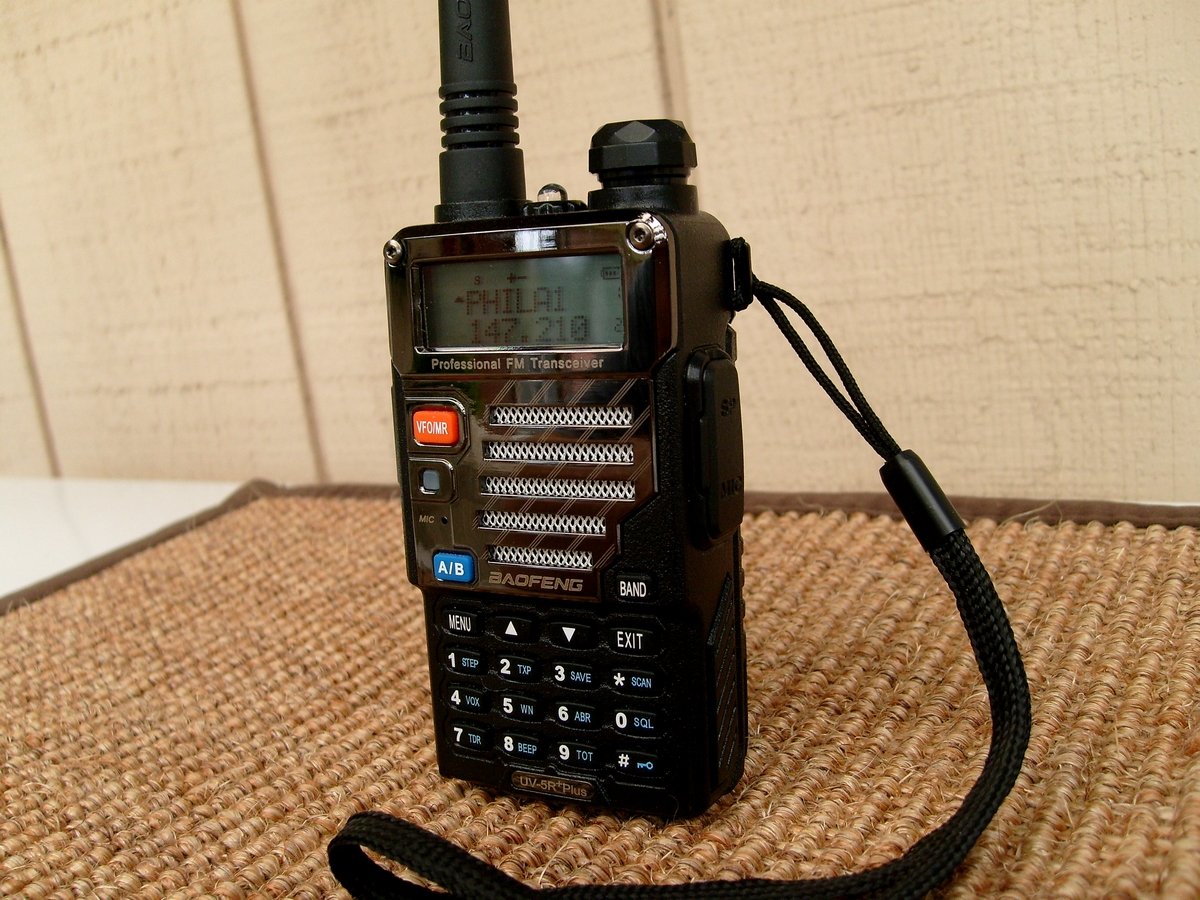
The F8HP is a typical thumb-sized HT — roughly 110 × 58 × 32 mm with the BL-8 battery installed, ~250 g with the stock antenna and battery — sized somewhere between the smaller VX-8DR (smaller chassis but heavier with battery) and the larger AnyTone D878 (bigger keypad, deeper chassis). Build material is injection-molded ABS with rubberized side panels at the PTT and microphone areas. Not submersible, not officially IPX-rated — a brief rain shower won’t kill it; an unplanned plunge into a puddle will.
1.2.1 Controls
The control layout is the canonical Baofeng dual-VFO arrangement: combined volume / power knob on top (clicks audibly into the off detent), SMA-Female antenna jack adjacent, orange flashlight LED beside that (controlled by the side MONI button). The 1.5” segment LCD shows both A-side and B-side simultaneously above a 4×4 keypad (0-9 plus A/B, BAND, VFO/MR, FM-radio, MENU, EXIT, UP, DOWN). Left side carries the Kenwood-K1-style 2-pin (3.5 mm + 2.5 mm) speaker-mic / programming jack with PTT, MONI, and CALL buttons. Bottom has the battery latch and charging contacts.
The dual-VFO display is genuinely useful — listen to a calling frequency on A-side while keeping a repeater pair on B-side, with PTT defaulting to whichever side is selected (A/B button toggles). The radio does not do true simultaneous receive; it dual-watches by rapid alternation, so a transmission on one side masks the other.
1.2.2 Antenna jack
A persistent gotcha. The radio has an SMA-Female jack on the chassis, meaning the antenna must have an SMA-Male connector. This is the opposite of the VX-8DR, AnyTone D878, and most other HTs (which are SMA-Male on the radio / Female on the antenna). When ordering, the Nagoya NA-771 is sold in two variants — NA-771G (SMA-Female, for Baofeng) and NA-771R / NA-771J (SMA-Male, for Kenwood/Yaesu/Icom). Read the suffix. An SMA gender adapter ($5) costs ~0.1 dB at 70 cm if you already own an antenna in the wrong gender (Antennas Vol 5 §9 for the adapter loss budget).
1.2.3 Battery
The radio ships with the BL-8 Li-ion pack — BaofengTech rates it at 2000 mAh nominal (verify capacity printed on the actual pack — TBD). Runtime depends almost entirely on TX duty cycle: at 5% TX / 5% RX / 90% standby at low power (1 W), ~16-20 hours; at 8 W high-power TX, 8-12 hours. An aftermarket BL-5L 3800 mAh pack ($25 mid-2026) roughly doubles runtime at the cost of doubling the radio’s depth — fine for shack/glovebox, awkward on the belt.
Charging is via a proprietary drop-in cradle with a 12 V / 1 A barrel-jack wall wart, ~4 hours empty-to-full for the BL-8 (cradle regulator is the bottleneck — current-limited well below what the cell can accept). No USB-C input on radio or cradle; a USB-PD-to-12V-DC pigtail covers field charging from a USB power bank (§7.4).
1.2.4 TX power per band
The F8HP datasheet rating, per the BaofengTech product page:
Table 1 — The F8HP datasheet rating, per the BaofengTech product page
| Band | High (W) | Mid (W) | Low (W) |
|---|---|---|---|
| 2 m (136-174 MHz) | 8 | 4 | 1 |
| 70 cm (400-520 MHz) | 8 | 4 | 1 |
The 8 W rating is honest within ~10% at band centre (146 MHz / 446 MHz); drops to ~6-7 W at the band edges. Spurious-emission performance is the well-known Baofeng caveat — 2nd-harmonic suppression around -50 dBc, 3rd around -55 dBc, both meeting FCC §97.307(d) by a comfortable margin but well below the -60-to-70 dBc of commercial-grade HTs. When this matters (operating near a sensitive RX, or a tight band-edge), an external low-pass filter cures it.
1.2.5 Receiver
RX coverage: 65-108 MHz (broadcast FM) + 136-174 MHz + 400-520 MHz. No AM-airband (unlike the VX-8DR), no HF, no SSB. Broadcast-FM receive is surprisingly useful with stereo headphones in the speaker-mic jack. Rated sensitivity ~-122 dBm for 12 dB SINAD on narrow-FM — a few dB worse than the D878, roughly equivalent to the VX-8DR. In practice, image-rejection and intermod are the limiters, not raw sensitivity; Baofengs splatter on receive near a strong nearby TX. An in-line bandpass filter cures it for fixed-position use.
Comments (0)