AnyTone AT-D878UVII PLUS · Volume 2
AnyTone AT-D878UVII PLUS — Vol 2: Operations
Top-tier DMR handheld with dual-receive, Bluetooth, APRS, AES
2.1 Operating modes
The 878 is a multi-mode handheld; the catalogue of what it actually does on the air, and how each mode is configured, is below.
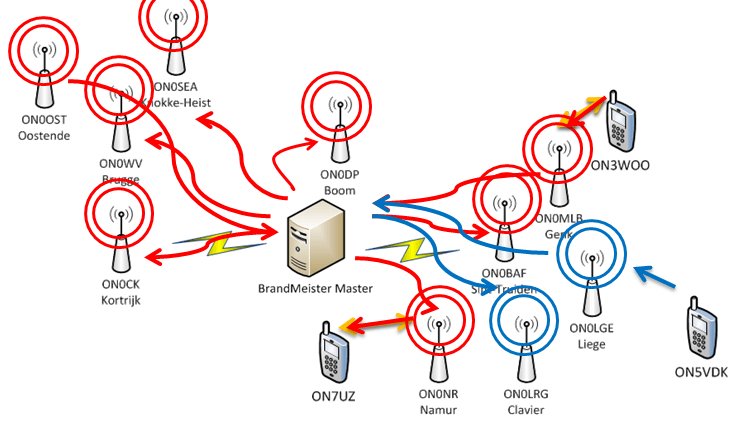
2.1.1 DMR Tier II (TDMA, two timeslots) — the primary mode
This is what the 878 is bought for. Tier II is the standard repeater DMR with two 30 ms TDMA timeslots interleaved on a single 12.5 kHz channel — a single repeater transports two simultaneous conversations on different timeslots without interfering. For amateur use, all BrandMeister, TGIF, and W0CHP-PiStar (WPSD) network repeaters and hotspots run Tier II. Per-channel configuration in CPS specifies the channel frequency (RX + TX simplex, or TX with a -5 / +5 MHz offset for a repeater split), the colour code (0-15, the DMR equivalent of analog CTCSS — a layer-1 squelch tone that must match the repeater), the slot (1 or 2 — for a hotspot, almost always slot 2 by community convention; for a repeater, depends on the repeater operator and is published in its repeater directory entry), and one or more associated talkgroups via an RX group list. The AnyTone implementation is mature — co-channel decoding, late-entry handling, and audio quality at the cell-edge are all noticeably better than the budget Chinese DMR HTs and on par with the commercial Motorola / Hytera kit it is competing against.
2.1.2 DMR Tier I (FDMA, simplex DMR) — direct-to-direct
Tier I is simplex DMR between two radios, no repeater involved, no TDMA timeslotting — both radios on the same frequency, same colour code, talking directly. Useful for tactical short-range work where you want the digital audio quality and the digital error-correction of DMR without the infrastructure dependency. The 878 supports Tier I but the talkgroup management is the same as Tier II — you still need a talkgroup ID configured on the channel, even though no network is involved. By DMR convention, TG 99 (Local) is the simplex talkgroup used for Tier I direct-to-direct in most US amateur communities (worth checking against your local repeater coordinator’s guidance — some areas use TG 9 instead).
2.1.3 Analog FM with CTCSS/DCS — the legacy fallback
The 878 is a perfectly competent analog FM handheld. CTCSS (PL) and DCS (DPL) per-channel encode/decode, narrowband (12.5 kHz) and wideband (25 kHz) selectable, 7 W on VHF / 6 W on UHF nominal TX (measured ~6.8 W / 5.4 W into 50 Ω at 7.4 V battery on this bench, mid-2026). Receive sensitivity is around -123 dBm for 12 dB SINAD on FM narrowband, which is competitive with the Yaesu VX-8DR and comfortably better than the Baofeng F8HP. The 878 will not replace a dedicated analog HT in audio character (the audio chain is digital-optimised and FM voice is slightly less “warm” than the Yaesu’s), but for “I need to hit the local 2 m repeater and the DMR repeater on the same radio without swapping antennas,” it’s fine.
2.1.4 AES-256 encryption — firmware option, regulatory caveat
The 878 II PLUS supports AES-256 encryption on DMR voice transmissions when the AT_Options expansion is flashed. The mechanism is per-channel: each channel can carry an encryption key index (0 = no encryption, 1-16 = one of 16 pre-stored keys), and a transmission on an encrypted channel will only be decoded by another radio with the matching key in the matching slot. The encryption is genuine AES-256 in OFB mode over the AMBE+2 vocoder output, distinct from the older DMRA “Enhanced Privacy” or “Basic Privacy” weak-scrambler modes (which the 878 also supports for back-compat with non-AES networks; both are trivially broken and not actually encryption in the cryptographic sense).
The regulatory caveat is the load-bearing piece: encryption is generally prohibited on US amateur bands per FCC Part 97.113(a)(4), which prohibits “messages encoded for the purpose of obscuring their meaning” except for explicitly permitted cases (control-link telecommand of an amateur space station, control-link telecommand of a model craft, and one or two other narrow cases). AES on amateur DMR is not in the permitted-exceptions list, and the FCC has historically interpreted the rule as banning enabled-encryption operation on amateur frequencies. AES is legal for some Part 90 land mobile work (where the 878 is not type-accepted, so you cannot legally use it for Part 90 work either), and there are gray-area arguments around emergency-services interop scenarios, but for routine amateur operation the AES-256 feature should be configured but disabled on all channels. The full deep treatment is in Antennas Vol 31 (Regulatory & RF Safety) §6 and Vol 22 (Frequency Planning) §7 ↗. The practical AT_Options unlock value is the other features it ships with — see §4.
2.1.5 Promiscuous mode (Digital Monitor) — the recon killer feature
“Digital Monitor” (also called “Promiscuous Mode” in the community) is the 878’s most useful operational mode for understanding what’s actually happening on a DMR network in your area. Normally a DMR receiver only decodes traffic that matches its configured colour code, slot, and talkgroup; everything else is rejected before the AMBE decoder. Promiscuous mode disables the colour-code, slot, and talkgroup filters and decodes anything DMR-shaped on the configured channel frequency. You hear every talkgroup active on slot 1 and slot 2 of that repeater, regardless of what’s in your codeplug.
Two flavours: single-slot promiscuous (decode any talkgroup on slot 1 OR slot 2 depending on which is selected on the channel) and dual-slot promiscuous (decode any talkgroup on either slot — the radio rapidly interleaves decode between slots, which means a small loss of audio at the slot boundaries but a near-complete view of the repeater’s activity). Toggle is via a programmable side button (default SK2 = single-slot toggle; long-press for dual-slot in newer firmware). Combined with the BrandMeister “last-heard” web feed (https://brandmeister.network/?page=lh) and a couple of minutes of listening, promiscuous mode lets you build an empirical view of which talkgroups are actually in use on your local repeater before you commit any of them to a codeplug entry. This is the “DMR network reconnaissance” workflow that makes the 878 (and its TYT/Retevis cousins, which also support promiscuous mode) qualitatively different from a more-locked-down commercial DMR HT.
2.1.6 Roaming — auto-switch to the strongest repeater
A roaming zone is a list of DMR channel entries (typically the same talkgroup on multiple geographic repeaters), with priority order and an RSSI threshold. The radio monitors the current repeater’s RSSI; when it drops below the configured threshold (default -110 dBm, tunable -90 to -125 dBm) for the configured dwell time (default 10 seconds, tunable 5-60 seconds), the radio scans the other repeaters in the roaming zone in priority order and switches to the strongest one above the threshold. Useful for mobile DMR — drive between repeater coverage areas without manually changing channels. Setup is fiddly (each entry in the roaming zone is a separate codeplug channel entry, and you have to keep the talkgroup IDs consistent across them) but once dialled in works well. The 878’s roaming implementation predates BridgeCom’s “roaming wizard” feature in the V4.xx CPS, which streamlines the setup considerably.
2.1.7 APRS — analog AFSK at 1200 baud, OR DMR data
The 878 has an internal TNC that supports two APRS transports:
-
Analog APRS over AFSK on a configurable VHF channel (typically 144.390 MHz in ITU Region 2, 144.800 MHz in Region 1) — standard AX.25 1200-baud Bell 202 signalling. Same APRS network as every other amateur APRS user; the 878 can beacon position (from its internal GPS) and decode received beacons. Messaging is supported but the keypad-based message entry is the usual amateur-HT pain.
-
DMR APRS over BrandMeister data services — APRS-equivalent position beaconing transmitted as a DMR data packet on a special talkgroup (TG 5057 — BrandMeister’s APRS gateway), which BrandMeister relays into the analog APRS-IS network. Useful if you’re in DMR coverage but not in APRS coverage; less useful where both networks coexist. Beacon interval is per-channel configurable (typically 5-30 minutes).
The DMR-APRS gateway is the more interesting mode operationally because it bridges the DMR network back into the broader APRS ecosystem; for a hotspot user with no nearby APRS digipeaters but full DMR coverage via the hotspot, it is the only APRS path that works.
2.1.8 Bluetooth audio + PTT — the mobile killer feature
The CSR8635 BT 4.2 chipset supports HSP/HFP profiles (handset/handsfree). Practically this means:
-
Bluetooth headset (any HFP-compliant single-ear or stereo headset — the JABRA Talk 25 works here with no issues, and the Plantronics Voyager Legend also works). Headset audio is mono regardless of the headset’s stereo capability (HFP-only, not A2DP). PTT is initiated by the headset’s call-answer button on most HFP headsets, configured via the BT pairing menu.
-
Bluetooth PTT button — a small dedicated BT HID device that maps a button press to the PTT trigger. BridgeCom sells the WBP-1 official BT PTT (~USD 50 mid-2026), and several generic BT PTT buttons (Senhaix, BTech BT-PTT) work for around USD 25-30. The PTT button pairs once and reconnects on power-on; useful for vehicle use where the HT is in a cup holder or belt clip and you don’t want to fumble for the side PTT.
Bluetooth latency is ~120-200 ms end-to-end, which is noticeable on simplex Tier I but not problematic on repeater Tier II (DMR’s own buffering and the network delay swamp the BT latency). Battery cost of leaving BT active is around 15-20% additional drain over BT-off operation.
2.1.9 Channel/zone/talkgroup capacities
Table 1 — Channel/zone/talkgroup capacities
| Resource | Capacity |
|---|---|
| Channels (analog + DMR combined) | 4,000 |
| Zones (channel collections) | 250 (with 250 channels per zone) |
| Talkgroups | 10,000 |
| DMR contacts (radioid.net DB) | 200,000 |
| Scan lists | 250 (with 50 channels per scan list) |
| Roaming zones | 64 (with 64 channels per roaming zone) |
| Hot keys / one-touch entries | 20 |
| Encryption keys (AES-256, AT_Options) | 16 stored |
200k contacts is enough to hold the entire current radioid.net DMR database (currently around 195k entries mid-2026 and growing slowly — the radio displays caller name + city + state on receive lookup, which makes BrandMeister chatter much more readable than a numbers-only ID display).
2.2 Field use
2.2.1 Antenna pairing
The stock 12 cm dual-band whip is acceptable for ~75% of operations — talking to the hotspot in the same room, or hitting a strong nearby repeater. For anything else, an upgrade pays back immediately. The first-tier recommendations:
- Nagoya NA-771 (~USD 25 mid-2026, ~40 cm whip, SMA-male centre pin — direct fit) — the budget upgrade that improves nearly every cheap dual-band HT. +2-4 dB over stock on 2 m, +1-2 dB on 70 cm. The default upgrade for the 878 + Baofeng + Yaesu trio. Caveat: counterfeit NA-771s are widespread on Amazon; the genuine Nagoya has a glossy black finish and a Nagoya-branded gold-tone SMA collar. The clones are matte and have a duller collar. Audibly different on RX (3-5 dB worse).
- Comet SMA-W100RX (~USD 40) — slightly longer (~45 cm), dual-band tuned, marketed as RX-extended (covers 100 MHz - 1 GHz with some gain across the band). The “if you can spend slightly more than the NA-771” pick.
- Smiley 270 SlimDuck (~USD 35) — Smiley Antennas’ US-made dual-band whip; 22 cm flexible whip designed for HT use. Better than the stock but shorter than the NA-771 — the right pick when you want better-than-stock without the NA-771’s “antenna bigger than the radio” form factor.
Second-tier (for vehicle / longer-range work, requires an antenna mount): NMO mag-mount with the Diamond NR-770HB (dual-band gain antenna, ~38” tall, +5.5 dB / +7.6 dB on 2 m / 70 cm respectively) on the vehicle roof, with a 3-5 m run of LMR-240 down to a BNC-female that adapts to the HT’s SMA-female with a short pigtail adapter. The 878 gets dramatically more range in a vehicle with a roof-mounted antenna; the HT antenna inside a Faraday-cage vehicle (especially modern coated-glass cars) is around 10-15 dB down from outside.
Deep treatment of antenna selection per radio: Antennas Vol 29 (Use-case Matrix). Portable monopole theory and the DIY + Buy duality: Antennas Vol 9 (Portable & mobile monopoles).
2.2.2 Hotspot pairing
The primary use case for the 878 in this setup is HT-to-hotspot DMR via the DIY WPSD hotspot, with the SkyBridge Plus as the commercial backup. The hotspot operates at 10-20 mW on a 2 m or 70 cm simplex frequency (the WPSD hotspot is on 70 cm at 432.875 simplex, a locally-uncoordinated frequency in the amateur band per local coordinator guidance — see Vol 22 §4 (DIY WPSD HotSpot — Frequency Coordination) ↗). The 878 talks to the hotspot at ~5-30 ft range with the stock antenna at low TX power (Mid or Low, ~1-2 W is plenty); the hotspot bridges the conversation to BrandMeister / TGIF / WPSD via the internet, giving access to any talkgroup on any network without needing a local DMR repeater in range.
Configuration on the 878 side: one zone called “HS-WPSD” containing one channel per talkgroup of interest, all on 432.875 simplex, all on slot 2 (community convention for hotspots), all on colour code 1 (default; matches the hotspot’s default). Talkgroups: 91 (BrandMeister Worldwide English), 3100 (BrandMeister USA Nationwide), 3162 (Michigan Statewide), 31660 (Michigan Regional), 9990 (Echo Test — the “ping a known-working talkgroup to confirm the path is up” channel), and whatever else is in current use. The hotspot zone is the most-used zone on the radio.
For direct-repeater use (no hotspot), the 878 hits any BrandMeister-connected DMR repeater in range — local repeater frequencies, offsets, colour codes, and talkgroups are documented in the local repeater council directory and at https://brandmeister.network/?page=repeater for any specific repeater. Each repeater gets its own zone with its talkgroups as channels.
2.2.3 Posture
The 878 is EDC / portable / handheld — belt-clip carry, docked to a desktop charger when not in use, occasional in-vehicle deployment with a BT PTT and either an external antenna or the WBP-1 BT speaker-mic. The most-used posture is “docked next to the laptop, BT-paired to a Plantronics Voyager Legend, monitoring TG 91 + TG 3162 in the background while working.” The radio is rarely truly portable in the sense of “carried on a hike” because the Baofeng F8HP or VX-8DR are both lighter and more drop-tolerant for that use; the 878 lives where it’s most useful, which is on the desk or in the car.
2.2.4 DMR ID and operational posture
DMR operation requires a DMR ID (registered at https://radioid.net — free, requires proof of amateur license, typically issued within 24 hours). The DMR ID is a 6 or 7-digit number that uniquely identifies the radio operator on the global DMR network. The operator’s DMR ID is configured into the codeplug at the radio-level options; without it, the radio will refuse to TX on any DMR channel. The DMR ID is per-operator, not per-radio — a single DMR ID covers both the 878 and any other DMR radio programmed for the same operator.
Talkgroup selection follows community norms — see Vol 2 §6 (Talkgroup hygiene) ↗ for the long version, but the short version: hot-button talkgroups (TG 91 Worldwide, TG 3100 USA Nationwide) are not for ragchew; QSO on TG 3162 Michigan or a regional / local talkgroup; use TG 9990 Echo Test to verify your path is up before keying TG 91 to see if anyone is listening. The 878’s promiscuous mode is the right way to discover what talkgroups are actually in use before committing them to your codeplug.
2.2.5 Bluetooth in vehicle
The Bluetooth pairing flow is the standard HFP pairing: enable BT in the radio menu, put the headset in pairing mode, the radio discovers it, confirm the 0000 PIN (most HFP headsets accept blank or 0000), pairing is persistent across power cycles. For the WBP-1 BT PTT button: same pairing flow; the button maps to a software PTT trigger. In-vehicle workflow: HT on the centre console in a cradle, BT speaker-mic on the visor, WBP-1 BT button velcroed to the steering wheel column. No wires. The setup is a meaningful improvement over the wired speaker-mic approach with the Yaesu or Baofengs.
Comments (0)