Yaesu VX-8DR · Volume 2
Yaesu VX-8DR — Vol 2: Operations
Quad-band ham handheld with GPS, APRS, and submersible IPX7 chassis
2.1 Operating modes
The VX-8DR’s mode envelope spans more bands and modulations than the headline “quad-band amateur HT” implies. The actual TX envelope is narrower than the RX envelope by a wide margin — this is a deliberate Yaesu (and FCC) design point, because the receive coverage is broad enough that allowing TX on every received frequency would put the radio out of compliance for the US market.
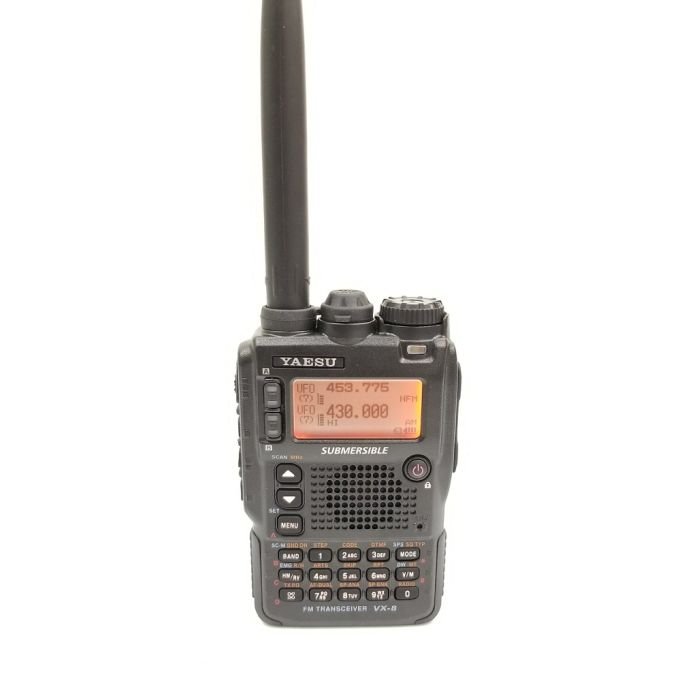
Amateur TX bands (US-market model, FCC Part 97):
- 6 meters (50-54 MHz), FM voice, up to 5 W output on the FNB-101LI Li-ion battery; reduced to ~2.5 W on the AA tray due to the lower battery voltage envelope. 6 m TX on a handheld is unusual — most quad-band HTs settled on dual-band 2 m / 70 cm — and it is a major reason VX-8DR retains value: 6 m sporadic-E openings during the summer months let a 5 W handheld with a half-decent antenna work surprising distances (regional QSOs across 500-1500 km are common during E-skip).
- 2 meters (144-148 MHz), FM voice, up to 5 W output. The workhorse band. CTCSS / DCS encode and decode for repeater access and tone-squelch.
- 70 centimeters (430-450 MHz), FM voice, up to 5 W output. The other workhorse. Same CTCSS / DCS support.
The 1.25-meter band (220-225 MHz) is receive-only on US models — Yaesu locked TX in firmware for the North American market because the radio’s 1.25 m output stage is not type-accepted for the band’s specific Part 97 power and bandwidth rules. Some operators have soldered the MARS modification (or located reflashable firmware variants) to enable 1.25 m TX, but on a US-licensed VX-8DR transmitting 1.25 m is outside the radio’s lawful envelope as shipped. RX on 1.25 m is genuinely useful in metropolitan areas with active 220 MHz repeaters (Detroit, Chicago, and the West Coast have particularly active 1.25 m communities).
Receive-only bands and modes:
- AM aircraft band (108-137 MHz), AM modulation. Air-traffic-control VHF voice, including the en-route, approach, departure, and tower frequencies. Useful at airshows, on the ramp, and for general aircraft-tracking interest.
- WFM commercial broadcast (76-108 MHz), wide-FM. Standard FM radio reception with stereo decoded to the mono speaker. Sensitivity is moderate (the radio is not a dedicated FM broadcast receiver) but adequate for in-vehicle entertainment when no other option is at hand.
- General wideband RX (0.5 MHz - 999 MHz with cellular gaps and a handful of frequency-range exclusions). Modes available include AM, FM-narrow, FM-wide, and the radio auto-selects the appropriate detector for the configured band by default. Cellular band gaps (824-849, 869-894 MHz for AMPS, plus the digital cellular bands) are blocked in firmware on US-market models per ECPA / Part 15 rules — this is firmware-enforced and not user-defeatable on a stock unit.
APRS — the standout feature. The VX-8DR has an internal TNC that does AX.25 framing, modem demodulation, and APRS packet generation entirely inside the radio. No external KISS modem (no Mobilinkd, no Kenwood TM-D710 paired host), no laptop, no Android tablet running APRSdroid. The TNC supports both 1200 baud Bell-202 AFSK (the universal APRS standard in North America) and 9600 baud G3RUH FSK (used in some regional networks and for digipeater backbones). Features:
- Position beaconing. The radio sources position from the FGPS-2 (if mounted) or from a manually-entered grid square or lat/lon. Beacon interval is configurable from 30 seconds to manual-only, with smart-beaconing as an option (interval shortens when moving fast, lengthens or pauses when stationary — drastically reduces channel pollution compared to fixed-interval beacons).
- Digipeating. The radio can act as a one-hop digipeater if configured, listening for packets with WIDE1-1 or WIDE2-1 paths and re-transmitting them. Off by default; turning it on without coordinating with the local APRS coordinator is poor form.
- Messaging. Text messages between APRS users, up to 67 characters per message, with optional acknowledgement. Composing messages on the keypad is slow (the keypad is alphanumeric like a feature phone, with multi-tap entry); pre-loading common messages via CHIRP or RT Systems is the practical workflow.
- Object beaconing. The radio can beacon the position of a named object (e.g., a club meeting location, a temporary event) separately from its own position.
Cross-band repeat. The dual-receive front end means the radio can act as a one-way or two-way cross-band repeater. The four cross-band configurations are: V/V (2 m in, 2 m out — same-band repeat, useful for extending a low-power HT’s reach through a vehicle-mounted VX-8DR with a better antenna), U/U (70 cm in, 70 cm out), V/U (2 m in, 70 cm out — the classic remote-hotspot configuration), and U/V (70 cm in, 2 m out — the inverse). Power output is configurable per side; typical use is half-power (~2.5 W) per side to keep heat manageable, since cross-band repeat exercises both PA stages simultaneously. Yaesu’s documentation cautions against extended-duration cross-band repeat without external power and a heat-sinking arrangement — the chassis gets noticeably warm after 10-15 minutes of continuous repeat operation.
Memory architecture. 1000 memory channels organized into banks (groups). Each memory carries: RX frequency, TX frequency (independent — supports any offset), CTCSS/DCS tone (encode and decode independently), name tag (16 characters max), bank assignments (a memory can belong to multiple banks), step size, power level, and modulation. Plus the conventional dual-watch / priority-channel features. The “1000 memories” sounds like overkill until you load a major-metro repeater directory (200-300 entries) plus APRS frequencies for several regions plus a few hundred scanner-style monitoring channels — at which point 1000 is comfortable but not extravagant.
No Bluetooth, no digital voice. The VX-8DR predates the Bluetooth-handheld generation (FT-3D / FT-5D / Kenwood TH-D74) and the C4FM digital-voice generation. It is FM-only on amateur bands, with no built-in C4FM, D-STAR, DMR, or P25 voice capability. The trade is real: you give up modern digital modes in exchange for a more rugged, more proven, simpler radio. For APRS-focused or analog-VHF-focused operating, this is not a meaningful loss; for someone who wants digital voice, the AnyTone D878 (Vol 8) or the FT-5D are the right picks.
2.2 Field use
Antenna pairing. The stock OEM rubber-duck antenna is broadband and mediocre — a typical pattern for a quad-band HT antenna, where covering 50 MHz / 144 MHz / 222 MHz / 440 MHz in a single 4-inch helical means none of the bands gets a properly resonant element. Performance is adequate for line-of-sight to local repeaters but loses 6-10 dB compared to a properly-tuned dual-band whip.
The universal upgrade is the Diamond SRH77CA (or the equivalent Nagoya NA-771, a 38 cm telescoping or fixed whip) — a half-wave on 2 m, ~5/8-wave on 70 cm, providing roughly +6 dB on 2 m and +3 dB on 70 cm versus stock. Cost ~$25 mid-2026. The SRH77CA is the genuine Diamond article (Japanese-manufactured, consistent quality); NA-771 is the broadly compatible name applied to a wide range of clone whips of varying quality (some good, some terrible). For VX-8DR use, the SRH77CA is the safer choice; for a $25 spend, the quality consistency is worth the small premium over a no-name NA-771. See Antennas Vol 29 (Use-case Matrix) for the broader per-radio recommendation framework and the 4-tier upgrade ladder, and Antennas Vol 9 (Portable & mobile monopoles) for the deep treatment of handheld-whip design and the half-wave vs 5/8-wave geometry tradeoffs.
For 6 m, the stock antenna is essentially worthless (a 4-inch helical at 50 MHz is not radiating efficiently in any meaningful sense). 6 m TX from a handheld is best done with a roll-up J-pole tossed into a tree (a 6 m J-pole is about 4.5 m total length — manageable as a portable antenna) or with a dedicated 6 m telescoping whip like the Diamond RH-789 (which is broadband but stretches to ~80 cm for 6 m operation). For APRS work, the SRH77CA is fine — APRS at 144.390 MHz lives on 2 m and the SRH77CA’s 2 m performance is exactly where the radio wants to be.
APRS operating posture. The North American APRS frequency is 144.390 MHz. Europe is 144.800 MHz. Australia is 145.175 MHz. The radio defaults to 144.390 from the factory but is fully configurable. Before transmitting APRS in a new region, check the regional APRS coordinator’s published frequency — the wrong frequency wastes power and adds nothing to the network. Beacon path defaults to WIDE1-1,WIDE2-1, which means the packet asks for one “fill-in” digipeater hop (WIDE1) followed by up to two backbone digipeater hops (WIDE2-1 — the 1 is the remaining hop count). This is the standard “new station, no special routing” path and is correct for almost all use. Smart-beaconing parameters worth understanding:
- Slow speed (typically 5 mph): below this speed, beacon at the slow rate.
- Fast speed (typically 60 mph): at or above this, beacon at the fast rate.
- Slow rate (typically 30 minutes): the long interval used when stationary or moving slowly.
- Fast rate (typically 90 seconds): the short interval used at highway speeds.
- Turn angle (typically 30°): on top of the interval rate, force a beacon when the heading changes by more than this angle.
- Turn time (typically 15 seconds): minimum time between turn-triggered beacons.
These defaults produce maybe 20-30 beacons per hour during highway driving, dropping to 1-2 per hour when parked. Fixed-interval beaconing at 1 minute (a common naive setting) produces 60 beacons per hour regardless of motion — channel pollution at the regional digipeater level. Use smart-beaconing.
Battery management. The FNB-101LI runtime envelope is roughly:
Table 1 — Battery management. The FNB-101LI runtime envelope is roughly
| Operating profile | Estimated runtime on FNB-101LI |
|---|---|
| GPS off, RX only, backlight low | 12-15 hours |
| GPS on, APRS beaconing 2-min interval, RX moderate | 6-8 hours |
| GPS on, APRS beaconing 30-sec interval, moderate TX | 4-5 hours |
| Continuous TX at 5 W (worst case) | 2-3 hours |
| GPS off, RX only, deep sleep between checks | 24+ hours |
For trips longer than a half-day with GPS engaged, carry a spare FNB-101LI or fall back to the FBA-39 AA-tray. A set of fresh AAs in the tray gives roughly 60-70% of the Li-ion runtime; lithium primary AAs (Energizer Ultimate) give noticeably better cold-weather runtime and somewhat better warm-weather capacity than alkalines. NiMH AAs (Eneloop) give about 50% of the Li-ion runtime due to their lower voltage envelope.
Submersion hygiene. IPX7 holds the radio against 1 m of fresh-water submersion for 30 minutes. Salt water is not a different ingress problem (the radio survives equivalently) but it is a different chemistry problem — salt residue accelerates oxidation of any unsealed metal surface, especially the SMA antenna joint, the battery contacts (if the battery is removed before rinsing), and the speaker grille. Discipline: after any salt-water exposure, rinse the entire radio in fresh water with the battery installed and all gaskets seated, dry thoroughly (including the speaker grille — invert the radio and let water drain for several minutes), and re-inspect the antenna O-ring within a week. Annual O-ring replacement is the conservative cadence for a marine-use radio.
Comments (0)