Xiegu X6100 · Volume 1
Xiegu X6100 — Vol 1: Introduction & Hardware
HF/6m with built-in tuner, color touchscreen, internal battery
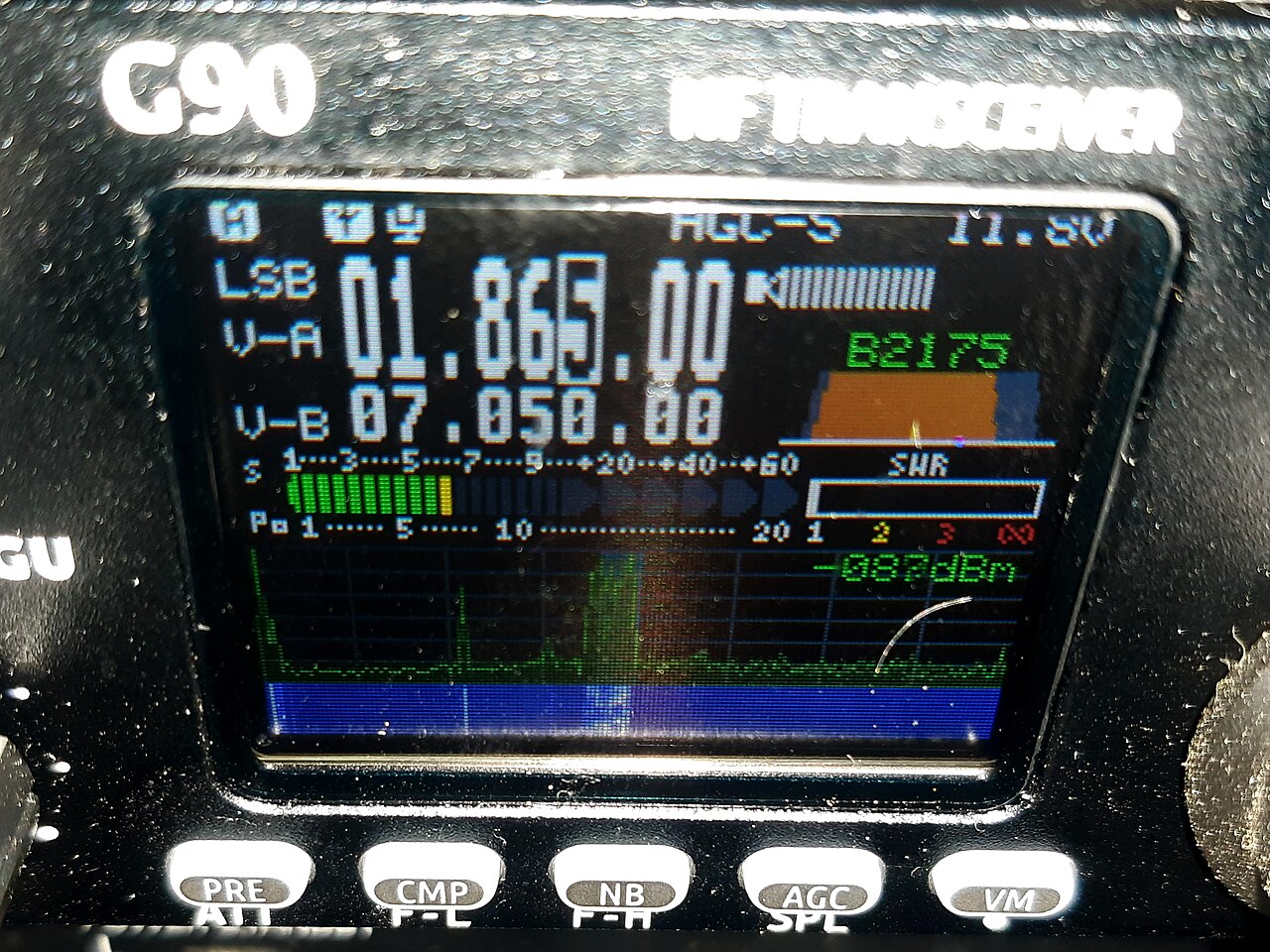
1.1 About this volume
The Xiegu X6100 is a portable HF + 6 m all-mode transceiver, introduced by Xiegu Technology (Chongqing) in late 2021 and shipped in volume from 2022. It earns its slot on the bench as the portable HF rig — the radio that goes into the backpack for POTA / SOTA / parks-on-the-air, sits on the picnic table with a wire in a tree, and also serves as the shack HF rig when fronted by the matching Xiegu XPA125B 100 W amplifier ↗. The X6100 is a stand-alone radio in a way the FT-818 / FT-817ND family never quite was — it carries its own battery, its own automatic tuner, its own speaker, and its own colour spectrum display. You can hand someone the box and a length of wire and they can make HF contacts.
The architecture is SDR — a direct-conversion / low-IF front end feeding an FPGA + ARM SoC running an Allwinner-flavored embedded Linux. The display side runs a Qt-based UI on the same SoC. This matters operationally for two reasons. First, the user interface is software, and the user interface can be replaced: the community Hello X6100 and Reform_xiegu_x6100 forks (and Xiegu’s own slowly-improving stock firmware) prove this. Second, the SDR architecture gives a panadapter / waterfall for free — there is no separate scope or P3 board to attach.
The competitive frame around the X6100 in mid-2026 is:
Table 1 — The competitive frame around the X6100 in mid-2026 is
| Class | Radio | Power | Tuner | Display | Battery | Street price (mid-2026) |
|---|---|---|---|---|---|---|
| Legacy all-band QRP | Yaesu FT-817ND / 818 | 5 W | None (external) | Small monochrome LCD | NiMH internal | $700-800 (818, used) |
| Modern portable HF SDR | Xiegu X6100 | 5-10 W | Internal auto | 4” colour TFT + waterfall | Li-ion internal | ~$680-740 USD |
| Icom flagship SDR | Icom IC-705 | 5/10 W | None (external) | 4.3” colour TFT + waterfall | Li-ion internal | ~$1,300 |
| Elecraft QRP | Elecraft KX2 / KX3 | 10/12 W | Internal auto | LCD (no waterfall) | Li-ion internal | ~$1,000-1,500 |
The X6100 wins on cost (it is roughly half the price of the IC-705 with broadly comparable feature surface), on integration (battery + tuner + speaker + display + radio in one box), and on display real estate (4” colour with a touchscreen). It loses to the IC-705 on front-end filtering / dynamic range (the IC-705 has cleaner roofing-filter behaviour around contest-strength signals), on mode coverage (no D-STAR), on firmware polish (Icom’s UX is significantly more finished), and on support longevity (Icom dealer network vs. importer-direct support for Xiegu). It loses to the FT-818 on band coverage (no 2 m / 70 cm — the X6100 is HF + 6 m only) and on proven reliability over a decade-plus. It loses to the KX2/KX3 on receiver performance (Elecraft’s roofing filters and DSP are the reference for the class) but undercuts them by a wide margin on cost.
There is one operational subtlety worth flagging up front. The X6100 has a documented history of front-end overload susceptibility in the presence of strong broadcast signals (medium-wave AM in particular, but also nearby HF broadcast on 49 m / 41 m / 31 m bands). Stock firmware versions before 1.1.7 (August 2023) shipped with the front-end attenuator menu hidden / disabled; later firmwares expose it. This volume’s operational guidance assumes 1.1.7 or later — verify firmware version first, update if needed. See §4 and §5.
This volume covers the X6100 as a stand-alone HF/6m rig. Volume 7 covers the XPA125B amplifier ↗ that pairs with it to make a 100 W home/portable station. Volume 21 covers the programming and CAT software (wfView ↗ primarily) that controls it from a host PC. Volume 22 covers the per-band frequency planning and Part 97 envelope that applies. For antennas, the cross-link is to the Hack Tools Antennas deep dive — specifically Vol 10 (Random-wire and end-fed) for EFHWs, Vol 6 (Single-band dipoles) for resonant dipoles, Vol 17 (Antenna tuners) for the matching-network context that the X6100’s internal tuner fits into, and Vol 29 (Use-case matrix) for the per-radio antenna recommendations.
1.2 Hardware tour
The X6100 is a roughly book-sized brick — approximately 6.3” × 3.7” × 1.6” (160 × 95 × 41 mm, TBD — verify against the unit; spec sheets list 160 × 100 × 38 mm but mid-production revisions vary), about 1.45 lb / 0.65 kg with battery. The body is a textured plastic-over-metal frame; the back is metallic and serves as a modest heatsink for the PA stage. Build quality is “good for the price” — better than the budget portable rigs of the previous decade, not as solid as a milled-aluminum FT-818 or the magnesium IC-705.
1.2.1 Front panel
The front panel is dominated by the 4” colour IPS touchscreen (800 × 480, the only screen on the radio — there is no separate frequency display). Below and to the right of the screen:
- Main tuning knob — large, weighted, smooth rotary encoder with optical position sensing. The tuning rate is selectable from the touchscreen (1 Hz to 1 MHz per step) and the knob has a “fast” multiplier when spun quickly. The knob does not have a clutch or drag adjustment — you get one tuning feel and that’s it.
- Multi-function knob — smaller rotary encoder + push-button, located top-right of the main knob. Push to cycle through what it controls: AF gain, RF gain, squelch, IF bandwidth, NR level, NB level, mic gain, power. The current assignment is shown briefly on-screen when you push.
- Four soft buttons along the top of the screen — F1/F2/F3/F4, context-sensitive labels appear on the screen above each. These walk through menu pages: VFO/MEM, mode select, filter select, AGC, NR/NB, tune, split, etc.
- PTT mic jack — RJ-45 socket on the front-left, electrically compatible with the Yaesu 8-pin RJ-45 hand mic standard (the same pinout as the FT-857 / FT-897 / FT-450 generation). A Yaesu MH-31 or MH-36 mic works without modification, as do the better aftermarket replicas (W2ENY mic kits, etc.). The supplied Xiegu mic is acceptable but unremarkable.
- Headphone / speaker jack — 3.5 mm stereo, switches off the internal speaker when plugged in.
1.2.2 Top panel
- CW key jack — 1/4” (6.35 mm) TRS, configurable per the menu as straight-key, iambic-A, iambic-B, bug, or external keyer pass-through. Tip = dit, ring = dah on iambic.
- External speaker jack — 3.5 mm, parallel-fed to the internal speaker (does not mute it; for muting, use the headphone jack).
- USB-C port — combined data + audio + charging. The USB descriptor enumerates as a composite device: CDC-ACM serial (for CAT, exposed as
/dev/ttyACMxon Linux and as a virtual COM port on Windows/macOS), and a USB Audio Class device (for digital-mode audio). The same port carries DC charging power at 5 V / 2 A. - Power button — momentary push, ~0.5 s press to power on, ~2 s to power off. Long-press also brings up the shutdown menu where you can choose to reboot or power off cleanly (graceful shutdown of the Linux side; matters because cutting power while the radio is logging or writing settings can corrupt the SD card).
1.2.3 Right side
- HF antenna jack — BNC female, 50 Ω. The choice of BNC over SO-239 is deliberate: BNC is quick-disconnect, robust enough for portable use, and lighter. Most operators carry a BNC-to-SO-239 adapter for connection to shack-style coax with PL-259 connectors. The internal tuner is reachable through this connector.
- 6 m antenna jack — separate BNC, 50 Ω. Routed to a separate PA / matching path internal to the radio. The 6 m connector is unswitched from the HF path electrically — feeding 6 m via the HF connector works but bypasses the 6 m-specific filtering and is not recommended for TX.
- External DC input — Anderson Powerpole connector (red/black, 30 A capable), 12.0-15.0 V DC range. Charges the internal battery if present and runs the radio simultaneously. Tolerates the typical 13.6-14.4 V from a regulated power supply or LiFePO4 pack.
- Ground stud — 4 mm threaded post for chassis ground / counterpoise connection. Useful for portable operations with end-fed antennas where you want a defined RF ground reference.
- SD card slot — microSD, used for firmware updates and (on community firmware) for audio recording, IQ capture, and CW message storage. Stock firmware uses it primarily as the firmware-update transport.
1.2.4 Internal battery
Internal Li-ion pack — typically reported as 2 × 18650 cells in series, ~3,000-3,500 mAh nominal at 7.4 V (Xiegu spec sheet says ~3 Ah; TBD — verify by opening the battery door and reading the cell labels on the unit, since Xiegu has revised the battery pack at least once between manufacturing runs). Runtime in typical SSB operation (50% RX, 50% TX at 5 W) is roughly 3-4 hours. On RX only (e.g. SWL or band-scanning at the kitchen table) the runtime stretches to 7-10 hours.
The battery is replaceable — there’s a removable back cover held by four Philips screws. Replacement packs are available from Radioddity (the US importer) for roughly $30-40 in mid-2026. Aftermarket 18650 conversion kits exist that let you swap loose protected cells in and out, but those are documented to confuse the X6100’s state-of-charge logic and the battery icon stops being accurate.
Charging via the USB-C port (5 V / 2 A) takes roughly 4-5 hours from empty to full. Charging via the Anderson Powerpole at 13.8 V takes 2-2.5 hours. The radio can be operated while charging on either input.
1.2.5 Internal automatic antenna tuner
The internal ATU is a relay-switched L-network with rough matching range 1.5:1 to 8:1 SWR, capable of bringing most random-wire and end-fed loads to better than 2:1 at the rig. Tuning cycle is ~6-12 seconds depending on starting mismatch; results are stored in non-volatile memory per band so subsequent tunes on the same band/antenna combination are near-instantaneous. Tuner bypass is available via a menu toggle for known-resonant antennas (saves no real time but reduces relay wear).
Two operational notes on the tuner. First, it is inside the radio’s antenna switching, so it is between the TX/RX path and the BNC connector — it cannot be bypassed at the connector level. Second, it has limits — a long-wire on the wrong frequency where the impedance happens to be near 0 Ω or near 5 kΩ may not match at all, and the tuner will report “tune failed”. The fix is to change the wire length, change the band, or add a few feet of counterpoise wire to shift the feedpoint impedance.
1.2.6 PA stage and TX output
The PA is a single-stage MOSFET final, delivering nominally 5 W output across HF (1.8 MHz through 28 MHz, all amateur segments) and 5 W on 6 m (50-54 MHz). Some firmware releases (notably 1.1.8+) enable a 10 W “boost” mode on HF — this draws more current, runs the final hotter, and is documented to be lower IMD product (cleaner SSB) than the equivalent 5 W output on competing radios. Use the 10 W mode sparingly in extended TX duty cycles unless you have airflow at the rear panel. The radio has thermal management — if the PA temp sensor exceeds an internal threshold (specifics not published, TBD — verify via the on-radio temp display), the radio will drop output power automatically and eventually lock TX entirely until cooldown.
The PA stage is the most failure-prone subsystem on the X6100 based on community-reported field returns. The most common failure mode is PA damage from sustained TX into a high-SWR antenna without the internal tuner engaged — protect by always running the tuner cycle when changing antennas, and never key down for more than a few seconds on an unverified antenna setup.
1.2.7 Internal speaker and audio
The internal speaker is a small downward-firing driver — adequate for solo bench listening, marginal in field use with wind or background noise. The audio output is roughly 1-2 W into the internal speaker, sufficiently loud to be heard but not high-fidelity. For SSB ragchew or contesting, plug in headphones or an external amplified speaker for noticeably better intelligibility.
Audio processing chain on RX is software DSP — variable bandwidth filtering (50 Hz to 6 kHz selectable), noise reduction (NR), noise blanker (NB), notch filter, and AGC with selectable attack/decay. The DSP is competent — comparable to entry-tier Yaesu and Icom but not at the level of the IC-705 or Flex SDR family.
Comments (0)