Baofeng UV-B5 · Volume 2
Baofeng UV-B5 — Vol 2: Operations
Earlier-generation Baofeng workhorse
2.1 Operating modes
Modulation and bands. Narrow-band FM voice on the 2 m amateur band (144-148 MHz US) and the 70 cm amateur band (420-450 MHz US, though firmware-default TX permissions usually open the full 400-480 MHz commercial UHF range — the operator is responsible for keeping TX on the amateur portion). No digital modes — no DMR, no D-STAR, no C4FM, no APRS internal TNC. Pure analog FM. Some firmware revisions also support narrow / wide deviation selection (12.5 / 25 kHz channel spacing); CHIRP exposes this per-channel.
Memories. 99 memory channels — meaningfully fewer than the F8HP’s 128. For most amateur use (local repeaters, simplex calling frequencies, a few utility / commercial monitoring slots) 99 is enough; for an operator who programs hundreds of regional and travel-itinerary channels, the F8HP’s 128 (or better, the AnyTone D878’s 4,000) is the better fit. The UV-B5’s memory structure is the simple flat-list layout — channels 1-99, each with a name, frequency, offset, tone, and power setting. No zones / banks / groups; CHIRP handles the flat layout transparently.
Tone signalling. CTCSS (Continuous Tone-Coded Squelch System — analog sub-audible tones, 67.0 Hz to 254.1 Hz) and DCS (Digital Coded Squelch — digital sub-audible code words). Both encode and decode are supported. Standard set of CTCSS tones matches the EIA TIA-603 list. This is what you need for repeater access on any modern repeater that uses tone-encoded squelch — the overwhelming majority do. Cross-link to Vol 2 (DMR network architecture) for the analog-tone-signalling primer if you need a refresher on what CTCSS and DCS actually do at the radio level.
Wide-band RX. The UV-B5 receives the FM broadcast band (commercial 88-108 MHz in the US — the firmware actually covers ~65-108 MHz to handle the European Band II 87.5-108 MHz allocation and OIRT 65.8-74 MHz) in addition to the amateur 2 m and 70 cm. Useful for casual broadcast listening; no stereo decode (mono output through the radio’s speaker). No AM airband RX — the UV-B5 does not demodulate AM, which is the gap that makes it less useful than the Tecsun PL-880 ↗ for monitoring 108-137 MHz aero traffic or any other AM voice transmission.
No trunking. This is an analog conventional radio. No P25, no DMR, no NXDN, no MotoTRBO. Trunked-system monitoring needs a Uniden SDS100 ↗ or equivalent.
VOX. Voice-operated transmit is available (selectable sensitivity). Mostly useful with a headset / speaker-mic; bare-radio VOX is awkward because the radio’s microphone picks up its own speaker.
Dual-watch. The UV-B5 alternates RX between two memory channels (or a memory + VFO) at a configurable rate. Useful for monitoring two repeaters; less useful than the F8HP’s somewhat-faster dual-watch implementation.
Overall: simpler than the F8HP, same architectural family (Chinese dual-band analog FM HT), fewer features, lower memory capacity. The architectural simplicity is part of why the CHIRP driver for it is so robust — fewer settings to expose, fewer revisions to chase.
2.2 Field use
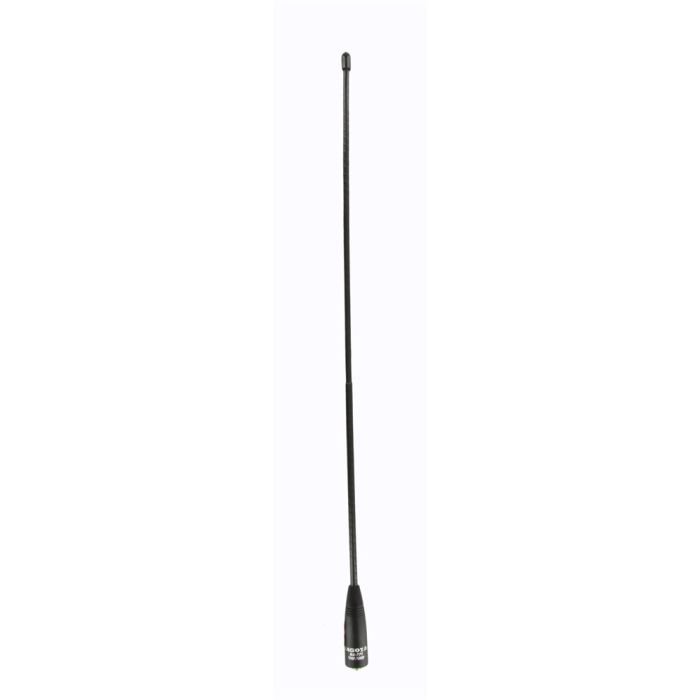
Antenna. The stock UV-B5 antenna is the short rubber-duck that ships with every Baofeng — mediocre on both bands, lossy, and the universal first thing to replace. The standard upgrade is the Nagoya NA-771 dual-band whip (~$25 mid-2026 from authentic-Nagoya channels; counterfeits are widespread on Amazon and eBay — check for the Nagoya holographic sticker and the moulded “NAGOYA NA-771” markings on the connector base). The NA-771 adds approximately +6 dB on 2 m and +3 dB on 70 cm compared to the stock antenna — meaningful, sometimes the difference between hitting a repeater and not. Same SMA-female convention as the radio’s SMA-male jack, so it screws on directly.
For deeper antenna context, cross-link to Antennas Vol 29 (Use-case matrix) in the sibling Antennas deep dive — the per-radio recommendations there cover the UV-B5 / F8HP / VX-8DR cluster (they all use the same form-factor of HT antenna, just with different SMA gender conventions) with a 4-tier upgrade ladder from stock rubber-duck through portable J-pole to mast-mounted home antennas. The deeper portable / mobile monopole treatment is in Antennas Vol 9 — covers the NA-771 design (helically wound base + telescoping element, λ/2 effective on 2 m), the alternatives (Signal Stick, Diamond SRH77CA, Smiley 270A), and the rationale for each.
Posture. The UV-B5 is the backup-of-the-backup handheld — the unit that lives in the bench drawer with a charged BL-B and an NA-771 already attached, ready to grab if the F8HP is unavailable or the AnyTone is on the charger and needed in a hurry. It’s also the loaner radio — the unit to hand to a visiting non-ham who needs to monitor a repeater alongside active operation, or to a beginning ham who’s between buying their first radio and getting their license. For these roles its limitations don’t matter (the user isn’t doing anything sophisticated) and its tactile rotary-knob channel-select is a feature, not a bug, for a casual operator who doesn’t want to learn menu navigation.
Battery management. Plan for degraded runtime from the aged BL-B. A fresh full charge gives roughly 4-6 hours of typical mixed RX/TX operation (vs. the original-spec 8-10 hours), call it 2-3 hours on heavy TX duty. Carry the desktop charger with you for any deployment longer than an afternoon. If the BL-B fails altogether, the radio is dead until a replacement arrives — there’s no AA-pack adapter (Baofeng never sold one for the UV-B5 form factor) and the desktop charger needs the battery installed to charge it (no direct-to-radio USB power).
Gotchas in field use.
- The rotary channel knob is easy to bump in a pocket or holster — channel changes happen unintentionally. Engage the menu-locked-knob option (menu item TBD — verify on the unit) if pocket-carry is the plan.
- The orange LCD backlight is dim relative to modern handhelds — adequate at dusk, struggles in direct sun.
- The PTT button is positioned where a tight chest-rig or holster will press it — accidental TX is a real risk in some carry arrangements. Belt-carry with the radio facing inward is safer than facing outward.
Comments (0)